
14 KiB
Kubernetes
Terminology
Pod
- Single container
- Multiple containers
- share ip
- share volumes
Node
Basically is a Kubernetes client or agent which runs a bunch of pods.
Service
- ClusterIP (default)
- NodePort ( access by port)
- LoadBalancer (external ip)
- ExternalName dns
Deployment
A Deployment provides declarative updates for Pods and ReplicaSets.
You describe a desired state in a Deployment, and the Deployment Controller changes the actual state to the desired state at a controlled rate. You can define Deployments to create new ReplicaSets, or to remove existing Deployments and adopt all their resources with new Deployments.
Replica Set
A ReplicaSet’s purpose is to maintain a stable set of replica Pods running at any given time. As such, it is often used to guarantee the availability of a specified number of identical Pods.
Service rolling update
DaemonSet
- running a cluster storage daemon, such as ·glusterd
,ceph`, on each node - running a logs collection daemon on every node, such as
fluentdor logstash. - running a node monitoring daemon on every node, such as Prometheus Node Exporter, collectd, New Relic agent, or Ganglia gmond.
StatefulSets
- Ordered, graceful deployment and scaling
- Stable, persistent storage.
- Stable, unique network identifiers.
- Ordered, graceful deletion and termination.
Proxy
DNS
- service.namespace
Secrets
For storing keys, credentials and certificates. For instance: database token, 3rd party API keys.
Persistent volumes
- Available
- a free resource that is not yet bound to a claim
- Bound
- the volume is bound to a claim
- Released
- the claim has been deleted, but the resource is not yet reclaimed by the cluster
- Failed
- the volume has failed its automatic reclamation
Several ways to access a service inside Kubernetes cluster
- ClusterIP, Can only be accessed inside the cluster. You can access inside
kubectl proxy - NodePort, You can access the service by a specific public port between
30000–32767, if the cluster server IP changes, then your service' endpoint url changes. - LoadBalancer, it's kind of external service, all the requests go through the loadbalancer. Every service needs a new IP for this.
- Ingress, can be shared among multiple services, you can have different types of ingress controllers:
gec,nginx,contour,istioand so on.
Links:
Zero down time deployment
Set strategy type to RollingUpdate instead of Recreate
spec:
  replicas: 1
  strategy:
    type: RollingUpdate
    rollingUpdate:
      maxUnavailable: 50%
      maxSurge: 1
Some useful commands
kubectl config set-context context-name --namespace default-namespace-name #default active context
kubectl config view #view config
kubectl get nodes #get nodes
kubectl get namespaces #get all namespaces
kubectl get pods #get pods
kubectl get deployments #get deployments
kubectl logs -f <pod> --tail 200 # tail logs from some pod
kubectl get services #get services
kubectl get ingress #get ingresses
kubectl get hpa # get horizontal auto scaling policies
kubectl get all # get all kinds of units
kubectl get secrets <secret-id> -o yaml #view a secret details with yaml format, fields are encrypted with base64
# List all Secrets currently in use by a pod
kubectl get pods -o json | jq '.items[].spec.containers[].env[]?.valueFrom.secretKeyRef.name' | grep -v null | sort | uniq

# List Events sorted by timestamp
kubectl get events --sort-by=.metadata.creationTimestamp

kubectl run -i --tty busybox --image=busybox -- sh  # Run pod as interactive shell
kubectl run nginx --image=nginx --restart=Never -n
mynamespace                                         # Run pod nginx in a specific namespace
kubectl run nginx --image=nginx --restart=Never     # Run pod nginx and write its spec into a file called pod.yaml
--dry-run -o yaml > pod.yaml

kubectl attach my-pod -i                            # Attach to Running Container

kubectl top pod POD_NAME --containers               # Show metrics for a given pod and its containers

kubectl config view -o jsonpath='{.users[].name}'    # display the first user
kubectl config view -o jsonpath='{.users[*].name}'   # get a list of users
kubectl config get-contexts                          # display list of contexts
kubectl config current-context                       # display the current-context
kubectl config use-context my-cluster-name           # set the default context to my-cluster-name

# add a new cluster to your kubeconf that supports basic auth
kubectl config set-credentials kubeuser/foo.kubernetes.com --username=kubeuser --password=kubepassword

# permanently save the namespace for all subsequent kubectl commands in that context.
kubectl config set-context --current --namespace=ggckad-s2

# set a context utilizing a specific username and namespace.
kubectl config set-context gce --user=cluster-admin --namespace=foo \
  && kubectl config use-context gce

kubectl config unset users.foo                       # delete user foo
Kubernetes port forward
kubectl port-forward allows using resource name, such as a pod name, to select a matching pod to port forward to Which is perfect for testing the remote service/pods in your local. e.g. Forward your db port to a local port, you can connect to your remote db even it doesn't have a public IP.
kubectl port-forward redis-master-765d459796-258hz 7000:6379

kubectl port-forward pods/redis-master-765d459796-258hz 7000:6379

kubectl port-forward deployment/redis-master 7000:6379

kubectl port-forward rs/redis-master 7000:6379

kubectl port-forward svc/redis-master 7000:6379
Kubernetes Dashboard
Deploy Dashboard
kubectl create -f https://raw.githubusercontent.com/kubernetes/dashboard/master/src/deploy/recommended/kubernetes-dashboard.yaml
Access dashboard
# First fetch cluster info, make sure cluster is running properly
kubectl cluster-info

# Normally the url for dashboard would be
http://your_ip:8080/api/v1/namespaces/kube-system/services/https:kubernetes-dashboard:/proxy/
Configure Kubectl to access remote Kubernetes cluster
Here is a very simple config which use HTTP and not secure, should only for local testing purpose
Config
Having a yaml file called config-demo in your current folder
apiVersion: v1
clusters:
- cluster:
    server: https://your_cluster_ip:5443
  name: development
contexts:
- context:
    cluster: development
    namespace: dev
    user: developer
  name: dev
current-context: dev
kind: Config
preferences: {}
users:
- name: developer
Connect to remote cluster
kubectl get all --kubeconfig=config-demo --all-namespaces
For long term usage, you will need to copy the content to your ~/.kube/config file
Helm
Add Kubernetes yaml template engine and the package manager for Kubernetes
How to use
helm init
helm upgrade --install -f abc/values-staging.yaml some-name ./abc
# abc/values-staging.yaml the value file
# some-name the release name
# abc the template folder
helm delete --purge mqtt  # mqtt the release name
Install 3rd party packages
helm repo add gitlab https://charts.gitlab.io/ # add remote repo
helm repo update # update index
helm install mirantisworkloads/vernemq
Tips
- Normally when you just updated the configmap the deployment or statefulset pod wouldn't updated, but you can add a label to deployment/statefulset yaml, when the value changes the pods will be recreated
template:
  metadata:
    labels:
      app: vernemq
      configmapVersion: "{{ .Release.Revision }}"
Deploy tools comparsion
https://blog.hasura.io/draft-vs-gitkube-vs-helm-vs-ksonnet-vs-metaparticle-vs-skaffold-f5aa9561f948/
Rolling update
Readiness Probe. Readiness Probe makes sure that the new pods created are ready to take on requests before terminating the old pods. To enable this, first you need to have a route in whatever the application you want to run which would return a 200 on an HTTP GET (Or other type) request.
apiVersion: apps/v1
kind: Deployment
metadata:
  name: hello-dep
  namespace: default
spec:
  replicas: 2
  strategy:
  type: RollingUpdate
  rollingUpdate:
    maxSurge: 1
    maxUnavailable: 25%
  selector:
    matchLabels:
      app: hello-dep
  template:
    metadata:
      labels:
        app: hello-dep
    spec:
      containers:
      - image: gcr.io/google-samples/hello-app:2.0
        imagePullPolicy: Always
        name: hello-dep
        ports:
        - containerPort: 8080
        readinessProbe:
          httpGet:
             path: /
             port: 8080
             initialDelaySeconds: 5
             periodSeconds: 5
             successThreshold: 1
maxUnavailable is an optional field that specifies the maximum number of Pods that can be unavailable during the update process. The value can be an absolute number (for example, 5) or a percentage of desired Pods (for example, 10%). The absolute number is calculated from percentage by rounding down. The value cannot be 0 if maxSurge is 0. The default value is 25%.
maxSurge is an optional field that specifies the maximum number of Pods that can be created over the desired number of Pods
initialDelaySeconds: Number of seconds after the container has started before readiness probes are initiated.
periodSeconds: How often (in seconds) to perform the probe. Default to 10 seconds. Minimum value is 1.
timeoutSeconds: Number of seconds after which the probe times out. Defaults to 1 second. Minimum value is 1.
successThreshold: Minimum consecutive successes for the probe to be considered successful after having failed. Defaults to 1. Must be 1 for liveness. Minimum value is 1.
failureThreshold: When a Pod starts and the probe fails, Kubernetes will try failureThreshold times before giving up. Giving up in case of liveness probe means restarting the Pod. In case of readiness probe the Pod will be marked Unready. Defaults to 3. Minimum value is 1.
Horizontal scaling
V1
apiVersion: autoscaling/v1
kind: HorizontalPodAutoscaler
metadata:
  name: worker-auto-scaling
  namespace: x-prod
spec:
  scaleTargetRef:
    apiVersion: apps/v1
    kind: Deployment
    name: <deployment-name>
  minReplicas: 1
  maxReplicas: 2
  targetCPUUtilizationPercentage: 75 # trigger point
V2
apiVersion: autoscaling/v2beta2
kind: HorizontalPodAutoscaler
metadata:
  name: php-apache
  namespace: default
spec:
  scaleTargetRef:
    apiVersion: apps/v1
    kind: Deployment
    name: php-apache
  minReplicas: 1
  maxReplicas: 10
  metrics:
  - type: Resource
    resource:
      name: cpu
      target:
        type: Utilization
        averageUtilization: 50
  - type: Pods
    pods:
      metric:
        name: packets-per-second
      target:
        type: AverageValue
        averageValue: 1k
  - type: Object
    object:
      metric:
        name: requests-per-second
      describedObject:
        apiVersion: networking.k8s.io/v1beta1
        kind: Ingress
        name: main-route
      target:
        type: Value
        value: 10k
Limit CPU and memory for pods
ports:
- name: db-port
  containerPort: 2345
  protocol: TCP
resources:
requests:
  cpu: 30m
  memory: 64Mi
limits:
  cpu: 200m
  memory: 256Mi
Kubernetes Operator
A Kubernetes Operator is an abstraction for deploying non-trivial applications on Kubernetes. It wraps the logic for deploying and operating an application using Kubernetes constructs. As an example, the etcd operator provides an etcd cluster as a first-class object.
An example Operator
- deploying an application on demand
- taking and restoring backups of that application’s state -handling upgrades of the application code alongside related changes such as database schemas or extra configuration settings
- publishing a Service to applications that don’t support Kubernetes APIs to discover them
- simulating failure in all or part of your cluster to test its resilience
- choosing a leader for a distributed application without an internal member election process
Use Operator
kubectl get SampleDB                   # find configured databases

kubectl edit SampleDB/example-database # manually change some settings
Some 3rd party operators
- Operator registry: https://operatorhub.io/
- Custom operators list: https://gist.github.com/philips/a97a143546c87b86b870a82a753db14c
- Prometheus operator: https://coreos.com/blog/the-prometheus-operator.html
Tools
Kubectx and kubens
Switch faster between clusters and namespaces in kubectl https
- kubectx for switching contexts
- kubens for switching namespaces
Github page: https://github.com/ahmetb/kubectx
Other distributions
OpenShift(OKD)
https://github.com/openshift/okd
OKD is the Origin community distribution of Kubernetes optimized for continuous application development and multi-tenant deployment. OKD adds developer and operations-centric tools on top of Kubernetes to enable rapid application development, easy deployment and scaling, and long-term lifecycle maintenance for small and large teams. OKD is also referred to as Origin in github and in the documentation. OKD makes launching Kubernetes on any cloud or bare metal a snap, simplifies running and updating clusters, and provides all of the tools to make your containerized-applications succeed.
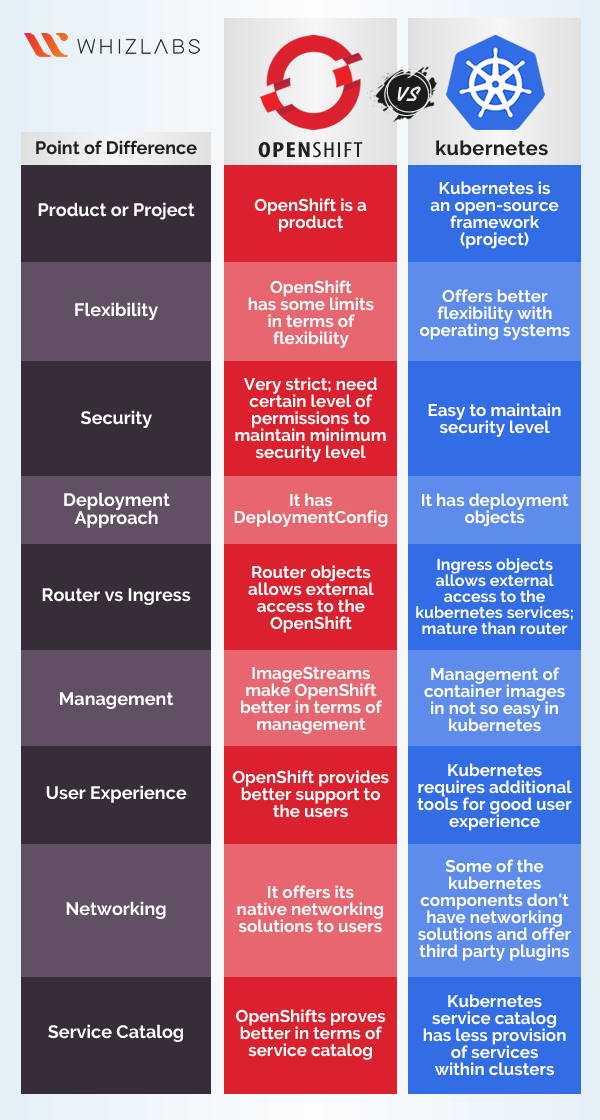
Differences
- More strict on security, for example you can't run docker images with
rootuser. - Better UI and come with some management tools.
- Integrated CI/CD
- It's a Redhat product, OKD is its open-source project
K3s
https://github.com/rancher/k3s
k3s is intended to be a fully compliant Kubernetes distribution with the following changes:
- Removed most in-tree plugins (cloud providers and storage plugins) which can be replaced with out of tree addons.
- Add sqlite3 as the default storage mechanism. etcd3 is still available, but not the default.
- Wrapped in simple launcher that handles a lot of the complexity of TLS and options.
- Minimal to no OS dependencies (just a sane kernel and cgroup mounts needed). k3s packages required
dependencies
- containerd
- Flannel
- CoreDNS
- CNI
- Host utilities (iptables, socat, etc)