mirror of
https://github.com/wahyd4/knowledge.git
synced 2026-08-09 05:06:28 +10:00

3.5 KiB
3.5 KiB
Relation
- Mysql
- Postgres
- Microsoft SQL Server
- Oracle
- Sqlite
NoSql
- Monodb
- Replica Set
- Primary
- Secondary
- Hidden
- Replica Set
- Redis
- Cluster
- Strong recommend 3 masters and 3 slaves
- Cluster
- Hbase
- Cassendra
SQL
Index
- Index is unique but not mandatory
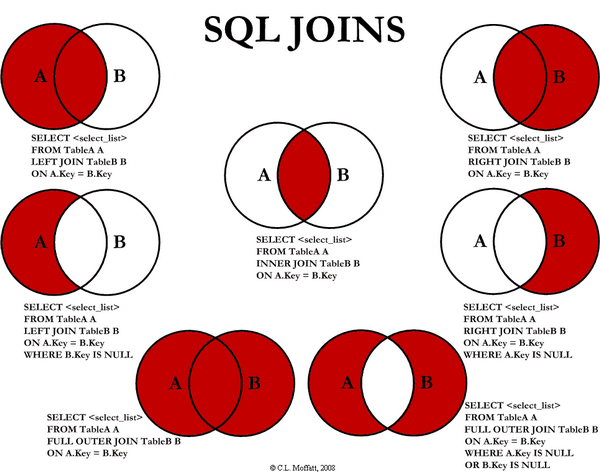
join
MYSQL
Tips
	- datetime
		- 8 bytes
		    `1000-01-01 00:00:00 ~ 9999-12-31 23:59:59`
		- store a absolute value
	- timestamp
		- 4 bytes `1970-01-01 08:00:01 ~ 2038-01-19 11:14:07`
		- will impacted by time zone
		- index by timestamp will be faster than datetime due to 4 bytes.
Postgres
Commands
\list # list databases
\c one # switch to datebase one
\dt list all the tables
Create a table
CREATE TABLE pm25
(
	id SERIAL,  -- id with auto increment
	time TIMESTAMP not NULL,
	pm25 integer DEFAULT 0,
	concentration integer DEFAULT 0,
	city VARCHAR not NULL
);
Import data from CSV
	COPY persons(first_name,last_name,dob,email)
	FROM 'C:\tmp\persons.csv' DELIMITER ',' CSV HEADER;
Import data with SQL
psql -U postgres -W -p 5432 -d somename -h 127.0.0.1 -f ~/somefile.sql
Create user
CREATE DATABASE yourdbname;
CREATE USER youruser WITH ENCRYPTED PASSWORD 'yourpass';
GRANT ALL PRIVILEGES ON DATABASE yourdbname TO youruser;
Update
UPDATE badges set type = 'onetype' where label != ''
Queries
Query with json field
select count(*), arguments ->> 'SomeProp', arguments -> 'FirstLevel' ->> 'SecondLevel' from jobs group by arguments ->> 'SomeProp', arguments -> 'FirstLevel' ->> 'SecondLevel'
Group by
select job_ids from (
	select count(*) as c, string_agg(cast(job_id as varchar),',') as job_ids, args ->> 'ResourceID' args -> 'Measurement' ->> 'Property'
	from  jobs
	group by args ->> 'ResourceID',  args -> 'Measurement' ->> 'Property'
) as f1 where c > 1;
Group by time
To get data entries grouped by time (minute/hour/day/month)
select
  date_trunc('day', created_at), -- or hour, day, week, month, year
  count(1)
from view_records
group by 1
If you want to group time base on a specific timezone and the timestamp field you choose contains that information.
select
  date_trunc('day', created_at AT TIME ZONE 'Australia/Melbourne'), -- or hour, day, week, month, year
  count(1)
from view_records
group by 1
If the time field doesn't have timezone information, we will need to ask postgres to intercept the time to the timezone we would like to use
select
  date_trunc('day', created_at AT TIME ZONE 'Australia/Melbourne') AT TIME ZONE 'China/Beijing')
  count(1)
from view_records
group by 1
Postgres trigger example
Giving we have a table called users, and the columns are:
id name age
1  tom  10
2  Dave  17
there is a requirement which is when some user's age turn to 18 move that person to adults table.
The adults table have the same fields with users.
The potential trigger implementation can be
CREATE OR REPLACE FUNCTION to_adults ()
	RETURNS TRIGGER
	AS $$
BEGIN
	INSERT INTO adults VALUES (new.*);
	DELETE FROM users WHERE age >= 18;
	RETURN NEW;
END;
$$
LANGUAGE plpgsql;

CREATE TRIGGER to_adults_trigger
	AFTER UPDATE ON users
	FOR EACH ROW
	WHEN (NEW.age >= 18)
	EXECUTE PROCEDURE to_adults();
SQL join diagram